---
title: "Old-School Syllabus vs Experiential Syllabus"
url: "https://books.playgoventure.com/3/newsletter/276/old-school-syllabus-vs-experiential-syllabus"
---
 # Old-School Syllabus vs Experiential Syllabus
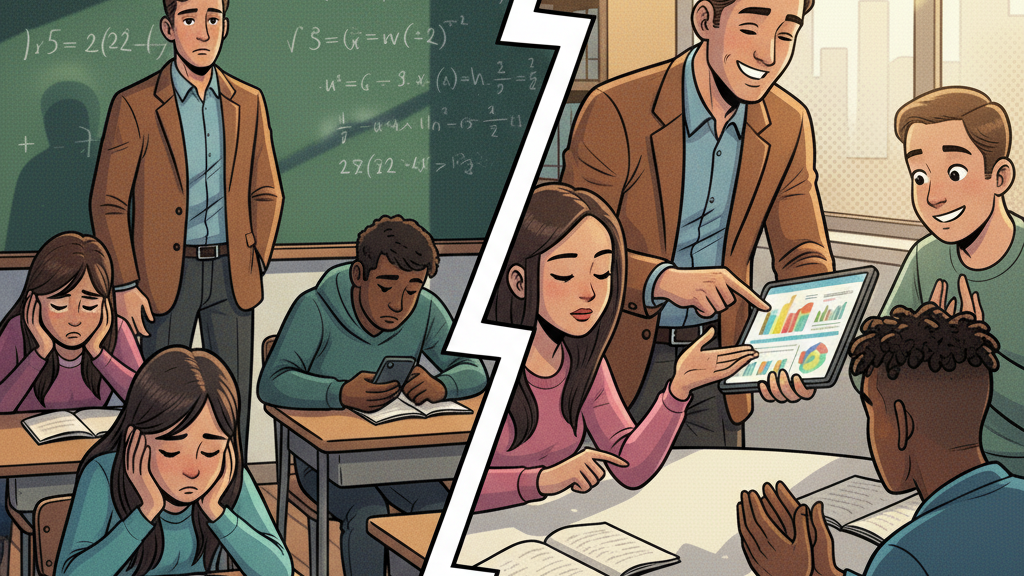
Here’s how I help instructors change their course curriculum and syllabus from **old-school** to **experiential learning** to achieve these benefits:
* Higher student engagement and less cheating
* More fulfilling experiences for instructors
* Better course and instructor ratings
* Increased school enrollments
Let’s start by reviewing a typical old-school syllabus. This syllabus is common in schools around the world — but it’s missing one big component.
**Typical Old-School Syllabus**
-------------------------------
1. Read textbook
2. Lecture and slides
3. Watch videos
4. Guest speaker
5. Discussions
6. Prepare case (no AI)
7. Quiz
**What’s missing?**
-------------------
To illustrate what’s missing, let’s imagine the course is on _**how to ride a bicycle**_.
Can you see what’s missing? Take another look — can you anticipate the question your students are going to ask?
Here it is — “**When are we going to ride the bicycle?**”
It seems quite obvious that to teach a course on how to ride a bicycle, you have to let students ride a bicycle.
What if the course was about business, marketing, or engineering?
**Should that be any different?**
Yes, riding a bicycle has more of a physical component than typical school subjects. But there’s also a lot of cognitive decision-making — how and when to use the brakes, how to change gears efficiently, how to maximize speed, how to conserve energy, and more.
So it’s not much different than learning other subjects and skills.
Yet, right now, in thousands of schools around the world, students:
* Learn business but never run a business
* Learn marketing but never sell anything
* Learn engineering but rarely build anything
It doesn’t make sense.
**Practice Makes Perfect**
--------------------------
To gain meaningful knowledge and repeatable skills, we need to give students the opportunity to practice. And not just a little bit of practice, a lot of practice.
Practice builds confidence. Confidence builds skills. Skills win jobs.
Looking at a typical **old-school syllabus**, notice that:
* Case studies are not practice.
* Textbooks are not practice.
* Lectures are not practice.
* Quizzes are not practice.
* Videos are not practice.
Doing is practice.
Experiential learning is practice.
**Experiential Learning**
-------------------------
To add practice to your syllabus, start by changing your mindset — become a **coach**.
❌ Don’t think in terms of delivering content and activities.
✅ Think in terms of facilitating experiences.
**From Old-School to Experiential**
-----------------------------------
Now, let’s transform the old-school syllabus into experiential —
### Experiential Syllabus | How To Ride a Bicycle
* **Ride Bicycle** (safely)
* **Balance & Pedaling —** Coaching, Exploration, Practice, Skill Test
* **Braking —** Coaching, Exploration, Practice, Skill Test
* **Gears —** Coaching, Exploration, Practice, Skill Test
* Etc.
Students ride the bicycle from the start and throughout the course, continually building their knowledge and skills.
**Coaching** means the instructor provides guidance, advice, and hosts discussions and debriefs.
**Exploration** means using a variety of learning resources to discover new knowledge — lectures, textbooks, videos, case studies, etc. These resources don’t go away, they are just used more effectively. For example, students can use them to learn more about braking, shifting gears, and other related concepts.
**Practice** means riding the bicycle. If you cannot do this in the real world, use games, simulations, and role-playing experiences.
**Skill Test** means assessing students to confirm they've achieved specific learning objectives.
**Give it a try**
-----------------
You don’t have to change your entire syllabus all at once — experiment by replacing underperforming activities with experiential learning. Discover the benefits and grow from there.
Or, completely transform the entire syllabus by designing or finding resources that can help you get there quickly and easily. It’s possible.
**One final tip** — If you try something new that you are unsure of, make your students feel part of the experiment. Give them the benefit of experiencing how innovation happens in the real world — through experimentation and iterative improvement.
# Old-School Syllabus vs Experiential Syllabus
Here’s how I help instructors change their course curriculum and syllabus from **old-school** to **experiential learning** to achieve these benefits:
* Higher student engagement and less cheating
* More fulfilling experiences for instructors
* Better course and instructor ratings
* Increased school enrollments
Let’s start by reviewing a typical old-school syllabus. This syllabus is common in schools around the world — but it’s missing one big component.
**Typical Old-School Syllabus**
-------------------------------
1. Read textbook
2. Lecture and slides
3. Watch videos
4. Guest speaker
5. Discussions
6. Prepare case (no AI)
7. Quiz
**What’s missing?**
-------------------
To illustrate what’s missing, let’s imagine the course is on _**how to ride a bicycle**_.
Can you see what’s missing? Take another look — can you anticipate the question your students are going to ask?
Here it is — “**When are we going to ride the bicycle?**”
It seems quite obvious that to teach a course on how to ride a bicycle, you have to let students ride a bicycle.
What if the course was about business, marketing, or engineering?
**Should that be any different?**
Yes, riding a bicycle has more of a physical component than typical school subjects. But there’s also a lot of cognitive decision-making — how and when to use the brakes, how to change gears efficiently, how to maximize speed, how to conserve energy, and more.
So it’s not much different than learning other subjects and skills.
Yet, right now, in thousands of schools around the world, students:
* Learn business but never run a business
* Learn marketing but never sell anything
* Learn engineering but rarely build anything
It doesn’t make sense.
**Practice Makes Perfect**
--------------------------
To gain meaningful knowledge and repeatable skills, we need to give students the opportunity to practice. And not just a little bit of practice, a lot of practice.
Practice builds confidence. Confidence builds skills. Skills win jobs.
Looking at a typical **old-school syllabus**, notice that:
* Case studies are not practice.
* Textbooks are not practice.
* Lectures are not practice.
* Quizzes are not practice.
* Videos are not practice.
Doing is practice.
Experiential learning is practice.
**Experiential Learning**
-------------------------
To add practice to your syllabus, start by changing your mindset — become a **coach**.
❌ Don’t think in terms of delivering content and activities.
✅ Think in terms of facilitating experiences.
**From Old-School to Experiential**
-----------------------------------
Now, let’s transform the old-school syllabus into experiential —
### Experiential Syllabus | How To Ride a Bicycle
* **Ride Bicycle** (safely)
* **Balance & Pedaling —** Coaching, Exploration, Practice, Skill Test
* **Braking —** Coaching, Exploration, Practice, Skill Test
* **Gears —** Coaching, Exploration, Practice, Skill Test
* Etc.
Students ride the bicycle from the start and throughout the course, continually building their knowledge and skills.
**Coaching** means the instructor provides guidance, advice, and hosts discussions and debriefs.
**Exploration** means using a variety of learning resources to discover new knowledge — lectures, textbooks, videos, case studies, etc. These resources don’t go away, they are just used more effectively. For example, students can use them to learn more about braking, shifting gears, and other related concepts.
**Practice** means riding the bicycle. If you cannot do this in the real world, use games, simulations, and role-playing experiences.
**Skill Test** means assessing students to confirm they've achieved specific learning objectives.
**Give it a try**
-----------------
You don’t have to change your entire syllabus all at once — experiment by replacing underperforming activities with experiential learning. Discover the benefits and grow from there.
Or, completely transform the entire syllabus by designing or finding resources that can help you get there quickly and easily. It’s possible.
**One final tip** — If you try something new that you are unsure of, make your students feel part of the experiment. Give them the benefit of experiencing how innovation happens in the real world — through experimentation and iterative improvement.
**Receive this newsletter by email** —
Join our **online community** where educators and trainers share ideas, resources, and discussions on experiential learning, games, and simulations — TeachingSuperhero.com
I'm Mathew Georghiou and I write about how games are transforming education and learning. I also share my experience as an entrepreneur inventing products and designing educational resources used by millions around the world. More about me at Georghiou.com