Help Me Design a Board Game — Part 12
It's been 5 months since my last update but we have continued to make progress.
Part 1 of this series started way back in August 2024, so it's looking like this is going to be a 2-year project from start to launch. Catch up by reviewing Parts 1 to 11 here.
Here's where we are now
We have refined our design style and components. The style might be described as a modern, semi-realistic, comic book or graphic novel. We recently determined that including a black stroke (outline) aligns better with our preferred style, so previous work had to be updated.
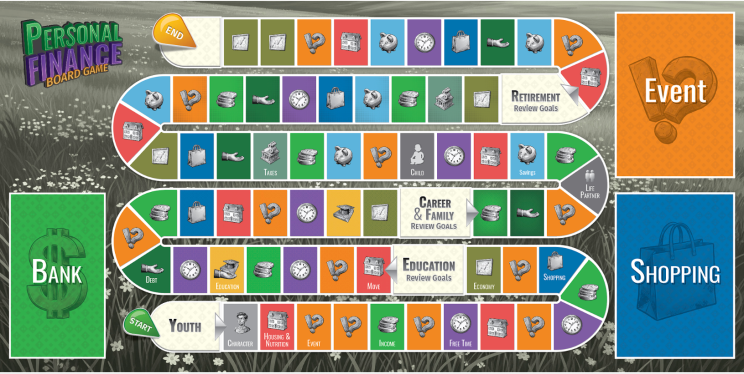
We applied the style to the gameboard and icons you see below.
The same action spaces are repeated several times as play progresses. They are all color-coded, which required several attempts at color selection.
To avoid having descriptive text on every space, or a separate legend to define each space, we only show the text on the first instance of a space.
We tried several backgrounds and are leaning towards a black and white treatment because the rest of the board is already very colorful. We are not sure if we will settle on the background shown below or not — more variations will be tested.
The product logo is a temporary placeholder.
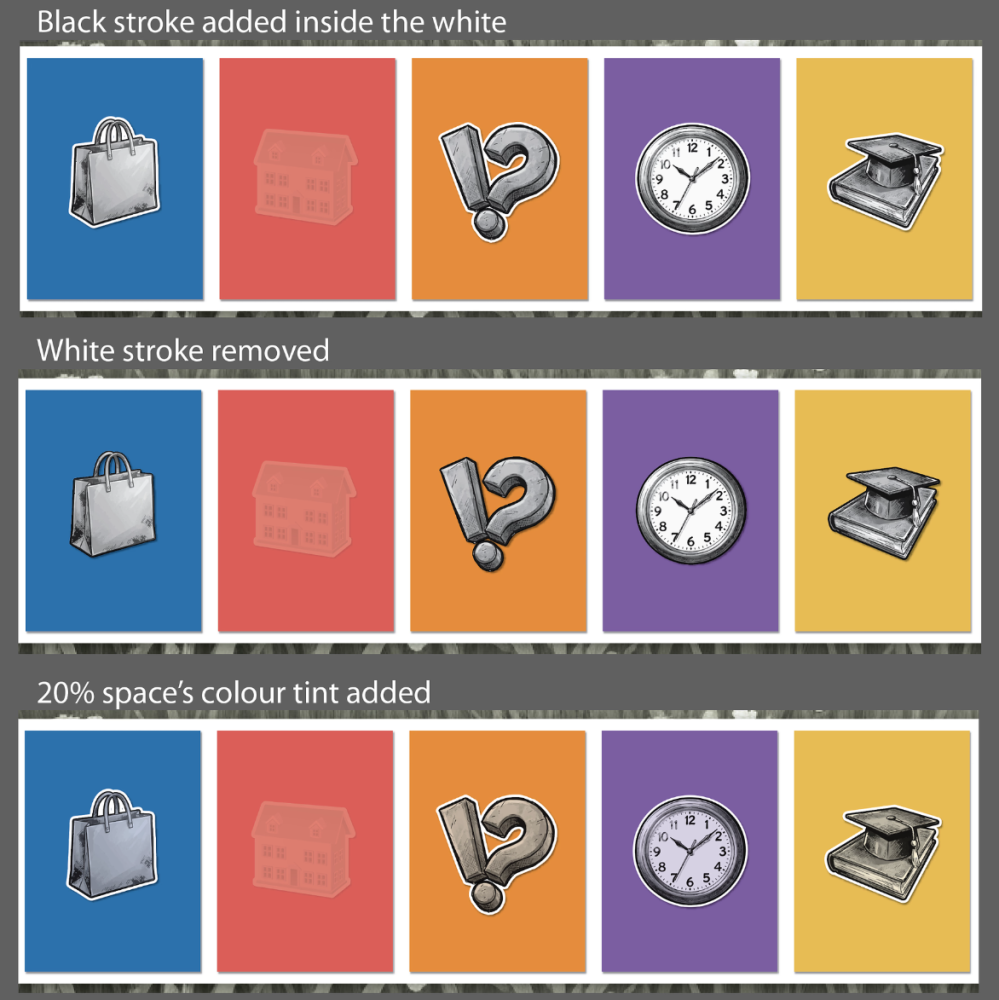
We compared small details like the stroke (outline) on the icons — we chose the middle one.
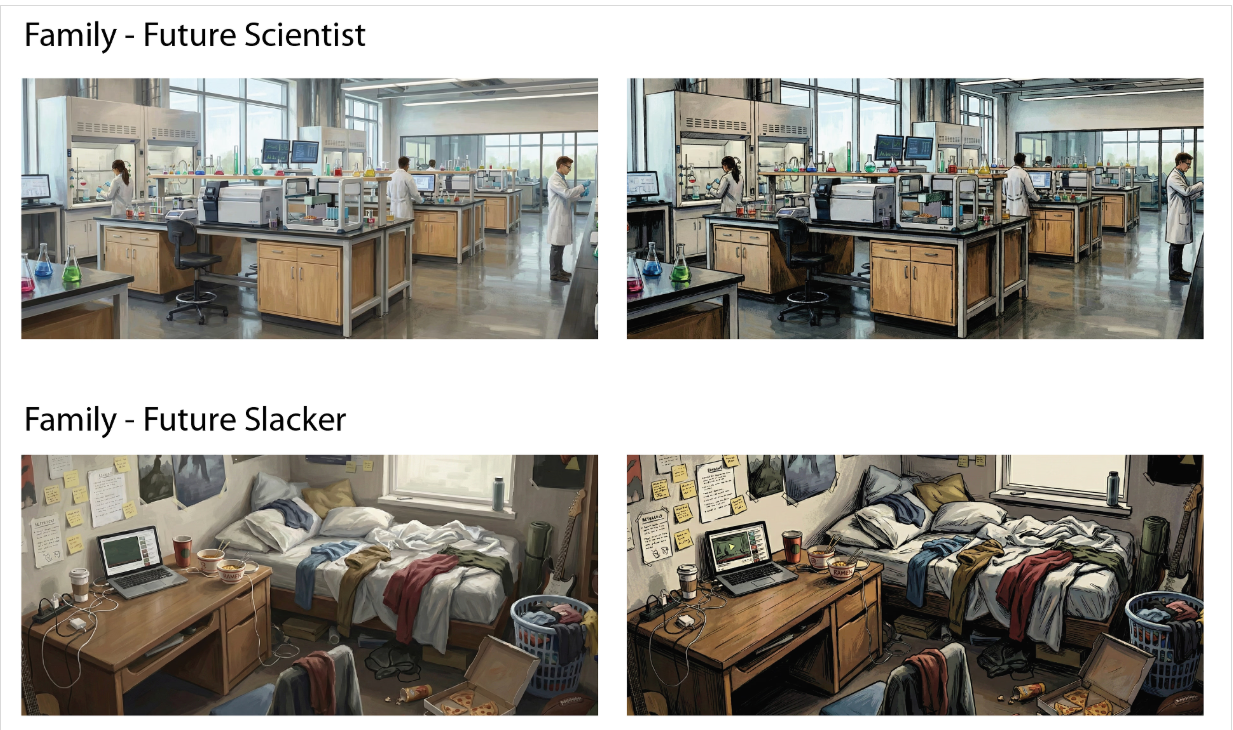
We then applied that same stroke style to the scenes that appear on the game cards. In the image below, scenes on the left are too photorealistic. The scenes on the right have the black stroke added and they align better with our chosen style.
We tried different fonts to find ones that best align with our chosen style. And which have spacing that accommodates the amount of text we need to include. This a sample image we created to compare a specific font treatment.

We explored whether text titles should be all caps, small caps, or title case. We settled on small caps. And determined that we prefer the numbers matching the color of the card — green card, green numbers; blue card, blue numbers.
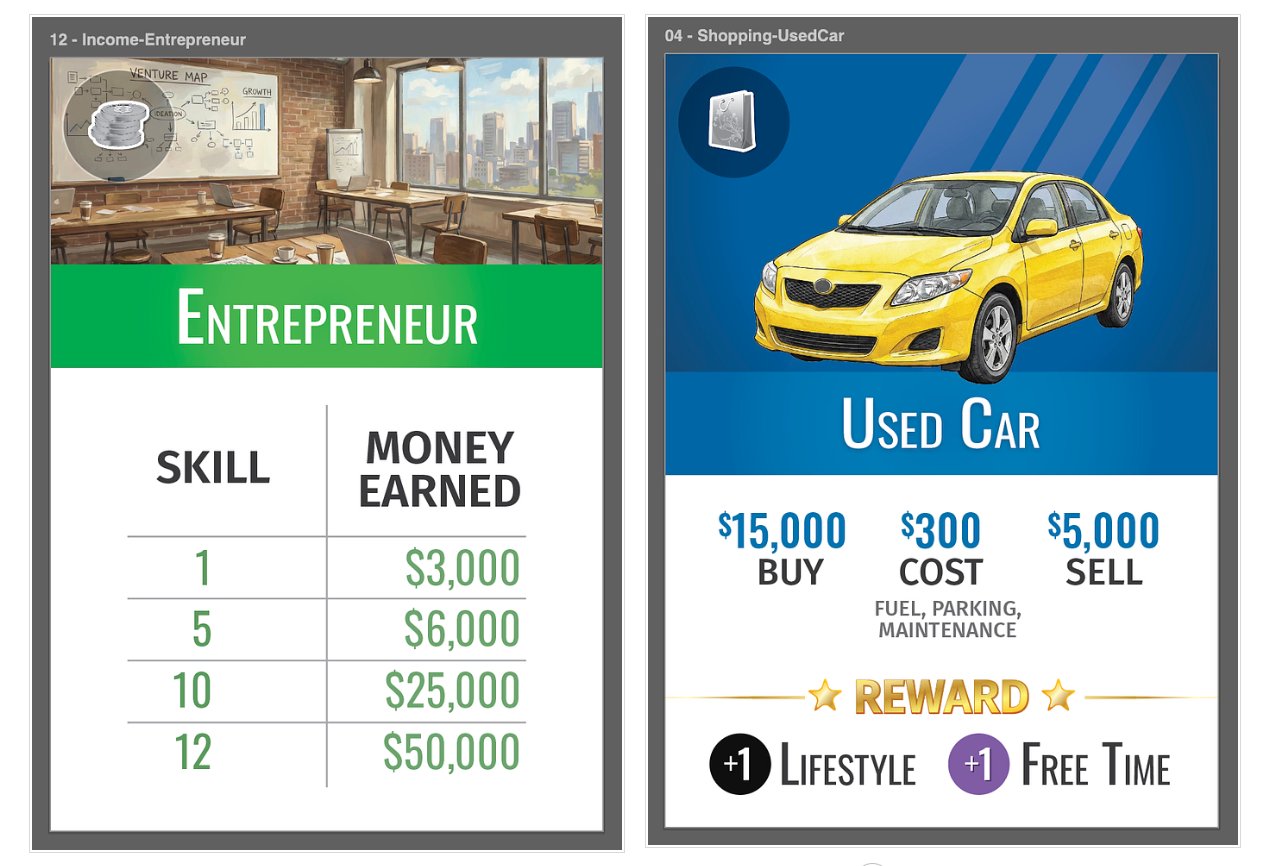
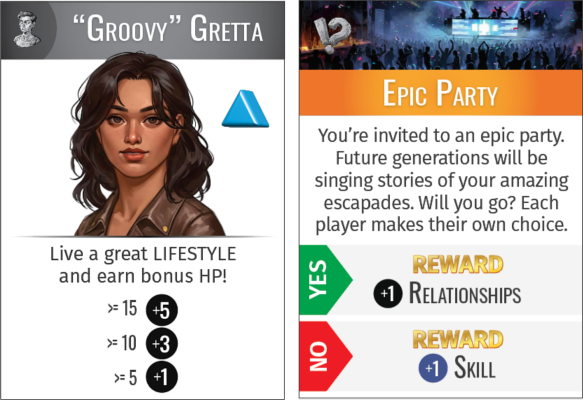
We finalized card layouts and how bonuses and rewards are displayed —
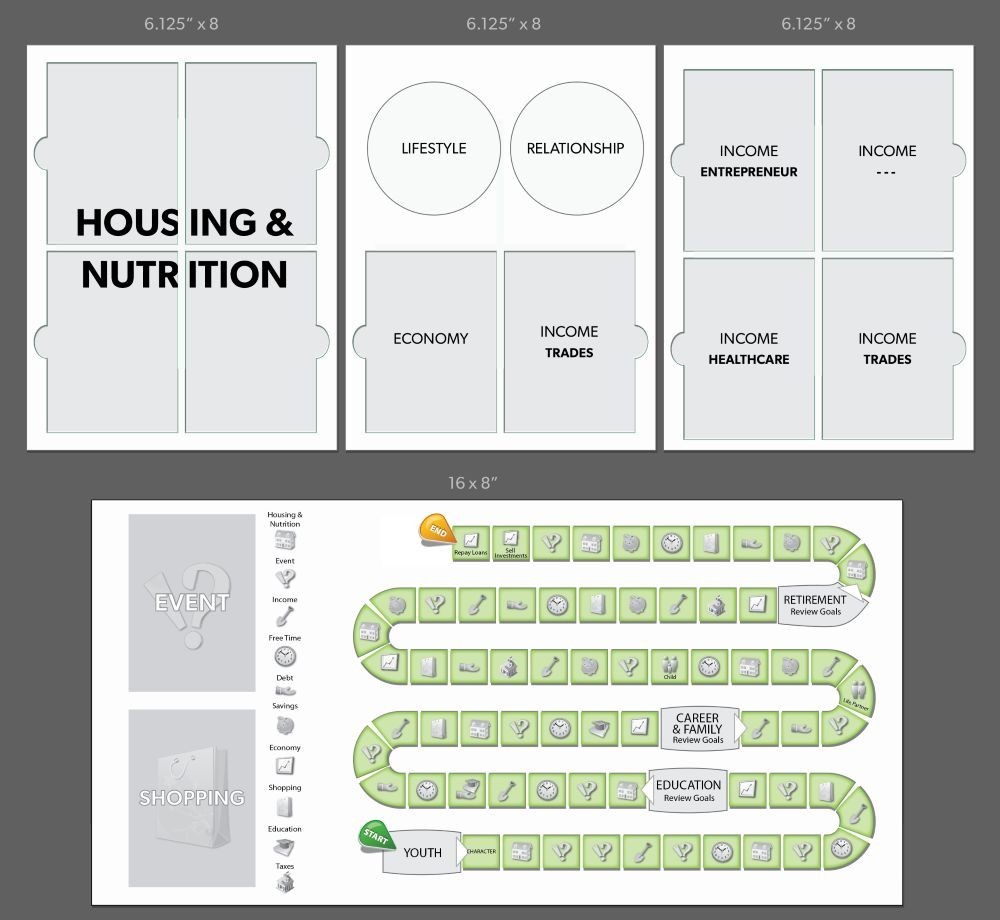
Here is the prototype from which we started working —
Play Testing
If you follow my updates, you may wonder why there hasn’t been more play testing earlier in the process. Play testing is typically very important in games designed for entertainment. Early play testing of the core gameplay can help assure the game will be fun — before much work is invested in components and graphics. And you can collect feedback on the theme.
The reason is that we are designing an educational game. The theme was set from the beginning — personal finance. It’s the sole purpose for creating this game. And we are using a literal implementation for maximum realism, not a metaphor. That was never going to change.
For the core gameplay, our imagination is bridled because we have to achieve specific learning outcomes in a short period of time. This is what makes designing educational games particularly challenging. In a game designed for entertainment, there are no limits on our imagination. If the game was designed for entertainment, we could have taken it in many directions — play testing would help identify the best path. But we don’t have that luxury.
Very early in the process, careful consideration was given to the type of gameplay that would allow us to achieve our instructional objectives. More robust play testing has to happen later in the process when the full experience is available. This means we have to be confident in our gameplay design early on. Having years of educational game-design experience helps with this.
Next Steps
Continue to refine and complete the visual design of all components.
Create and complete game content and refine through play testing.
Get the design files ready for press.
Share Your Thoughts In the Comments
Post comments in our Teaching Superhero Community
Am I on track?
Am I missing something?
Do you have any suggestions?
Should I keep posting about this game?
PS: Please only share ideas if you are willing to allow me or anyone following this discussion to use them for free without any obligation. If you contribute an idea that has a significant influence on the design of my game, I will be pleased to gift you a copy of the game.
I'm Mathew Georghiou and I write about how games are transforming education and learning. I also share my experience as an entrepreneur inventing products and designing educational resources used by millions around the world. More about me at Georghiou.com