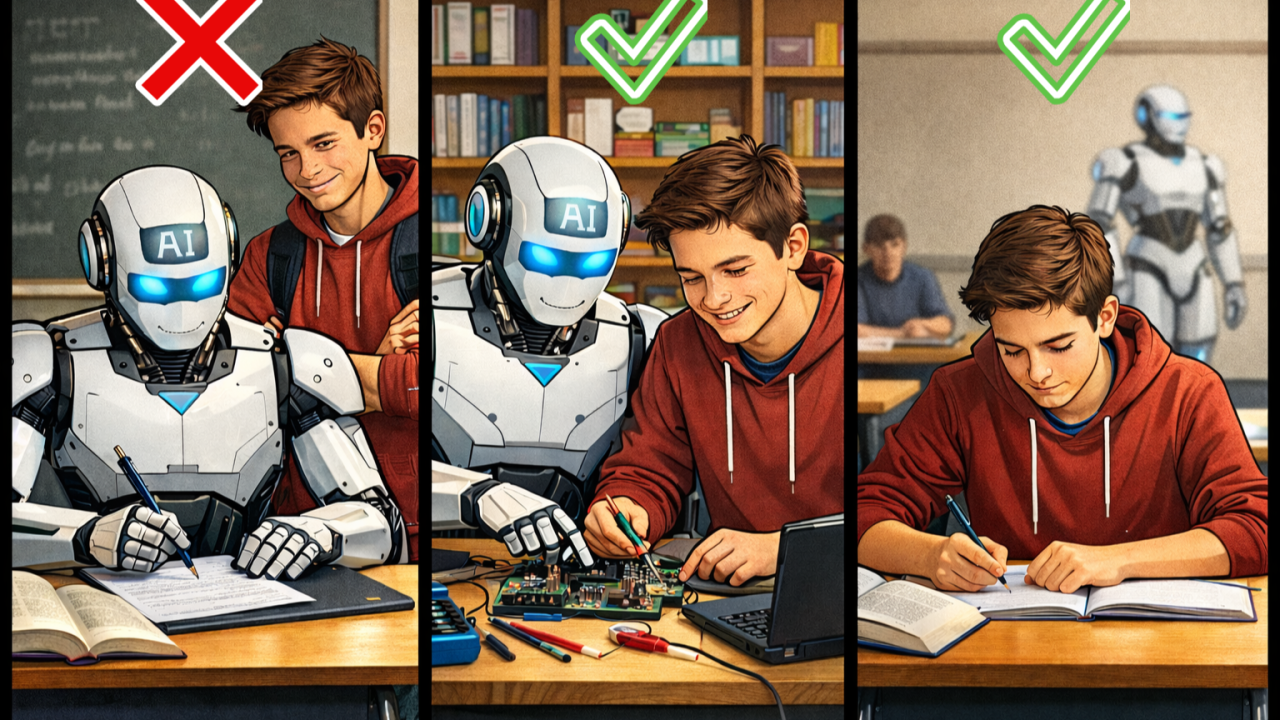
Banning AI in Schools Is Not an Option
Trying to ban AI today is like trying to ban the Internet 20 years ago.
Technology always changes how we work and learn.
AI is transformational and already everywhere — in students’ pockets, at home, with their friends, at the library, and at work. Soon it will be ubiquitous. So how practical is it to try to ban it?
Some argue that society bans smoking, alcohol, and other dangers from young people. True. But those things are health risks, not tools for learning and productivity. They’re also not already in everyone’s pocket or becoming essential employment and life skills.
Does AI hallucinate? Yes.
Can AI be dangerous? Yes.
Does AI make mistakes? Yes.
Can AI compromise learning? Yes.
With this list of Yes’s, shouldn’t we advocate for more education, not less?
More education to help instructors use AI wisely.
More education to help students use AI responsibly.
You can’t gain AI skills without using AI — conversations are not enough. Hands-on practice is required. (PS: I don't sell AI products or services.)
Practice is the best way for humans to gain confidence and skills.
Speaking of humans, all of those risks listed above — we can replace “AI” with “humans” and the answers are the same. We are all well aware of the barrage of misinformation, manipulation, and scams spreading through our communication channels.
More education is the only way we can protect ourselves from these dangers — whether they originate from humans or machines.
Many fear that using AI strips away the ability to think.
And while that can be true, it’s also a very narrow view of how AI can be used in learning.
The very same AI that replaces thinking can also enable us to expand our thinking and creativity. We can explore ideas and create things that would never have been possible before.
Here's a simple example — Consider the enormous amount of human energy wasted over the past 30 years creating PowerPoint slide decks — dragging boxes, tweaking fonts, fixing colors, fighting charts. Instead of teaching students to think deeply about how to best communicate an idea, we trained them to wrestle with software.
The key is to change the school curriculum to strategically use AI — and sometimes not use AI.
This does not mean turning teachers into AI experts or content creators. It does not mean training students to be better employees or exposing children to unsafe systems.
It means helping instructors and students understand when AI is useful, when it isn’t, and how to think critically about its output. It also means using AI to unlock creativity — helping students activate skills they may not yet have, or may never develop otherwise.
Like every tool invented in human history, it ultimately comes down to how it’s used.
Related articles:
Could Educators Be Contributing to the Next Digital Divide Without Realizing It?
Universities Have 3 Years to Change Before AI Crushes Enrollments
I'm Mathew Georghiou and I write about how games are transforming education and learning. I also share my experience as an entrepreneur inventing products and designing educational resources used by millions around the world. More about me at Georghiou.com