
How Instructors Can Use AI to Stop Students From Using AI (Not an AI Detector)
Here’s one way I’m designing assessments to deter students from using AI to do the work and the thinking for them.
This assessment method provides instructors with student proof of work, proof of performance, and evidence of learning.
In this example, students complete a business simulation and are required to journal about their decisions after each period. Student entries are locked so they cannot change them later, providing evidence that they are journaling while making decisions in the simulation.

Students are asked to answer the same question each time:
Reflect on past results and record your strategy for the upcoming event. Describe each of the following:
(1) Metrics that are doing well.
(2) Metrics that need improvement.
(3) Actions you are taking to improve.
It’s a simple journal activity— but one focused on each student’s personal decision making and performance. Every simulation is unique to each student, so there is no single answer to copy or find on the Internet.
The instructor can manually review every journal to assess how accurate and thoughtful the entries are. But that’s a lot of work if you have a lot of students (some of the instructors I work with have hundreds in the same course).
Instead, the instructor can use AI to do the heavy lifting.
The AI will review and compare each student’s Strategy Journal entries with that student’s specific simulation results. If a student posts information that is inconsistent with their simulation results, the AI will flag it for the instructor. If a student provides little meaningful reflection or enters gibberish, the AI will flag that too.
The AI will then prepare a report for the instructor with a summary that helps them quickly determine whether a closer look is needed.
Here’s what an AI summary looks like:
The student demonstrated adequate operational management within the simulation, achieving high overall scores in financial and performance metrics (including an 88% total Skill Score and a 100% Problem Solving score). However, the Strategy Journal analysis is inconsistent across the season. While entries during Events 2–11 accurately listed simulation metrics and aligned with chosen Management Focus decisions, several entries contain off-topic responses, placeholder content, or gibberish text (specifically in Events 1, 12, 13, and 14).
Recommendation: ⚠️ Borderline — instructor review recommended
Notice that it’s designed to assist the instructor in making a judgment rather than replace the instructor’s judgment.
The overall assessment is typically based on three weighted elements:
- Playing the simulation.
- Performing well in the simulation.
- Completing a thoughtful Strategy Journal.
Combined, these provide proof of work, proof of performance, and evidence of learning.
And it's one way that AI can help instructors deter students from using AI to do the work for them.
Here is the full AI report.
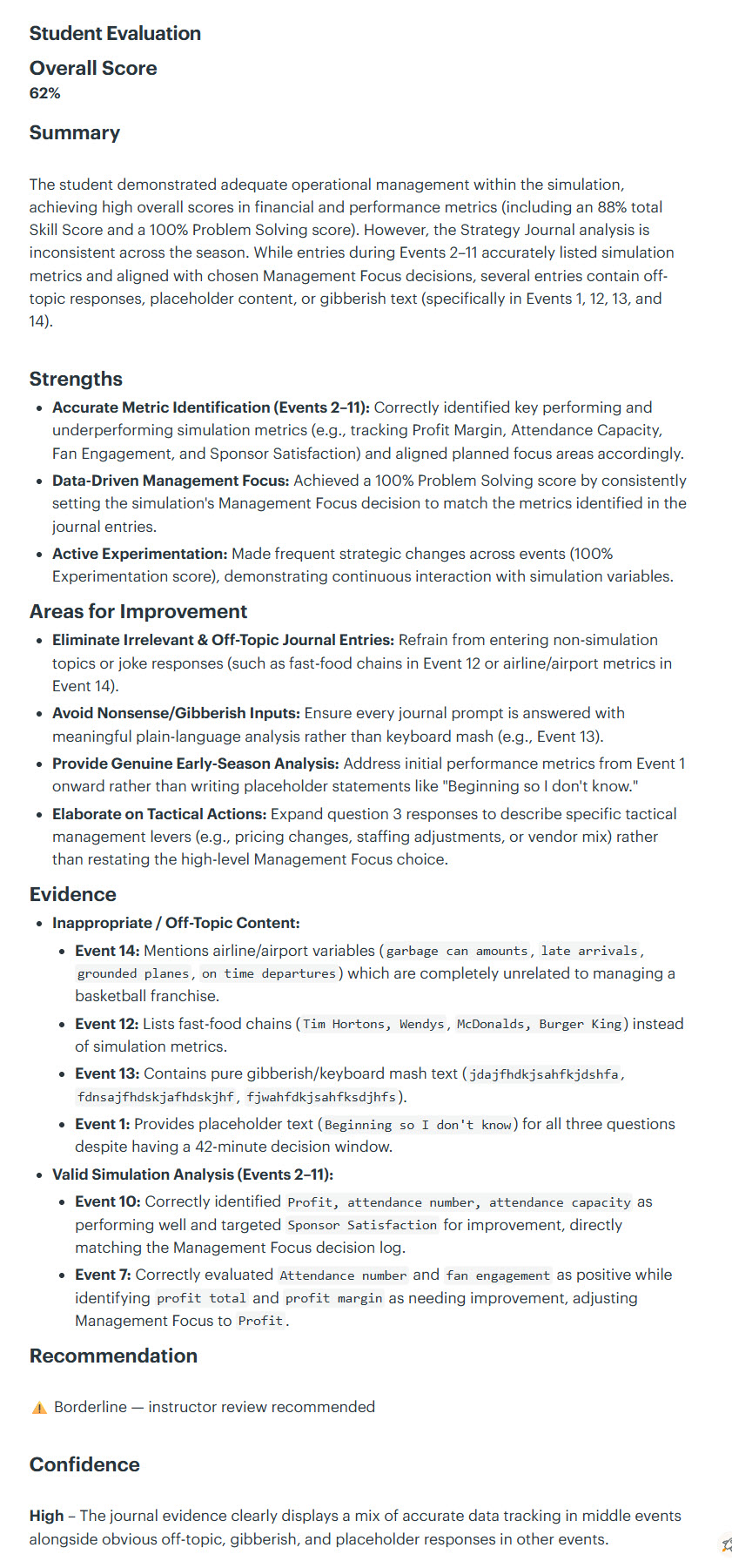
The simulation used in this example is GoVenture Sports & Entertainment Management
I'm Mathew Georghiou and I write about how games are transforming education and learning. I also share my experience as an entrepreneur inventing products and designing educational resources used by millions around the world. More about me at Georghiou.com